Gong bath and singing bowls: what sound healing is and how it works
What a gong bath is, how a singing bowl session unfolds, its effects, contraindications and how to choose a serious sound healing session.
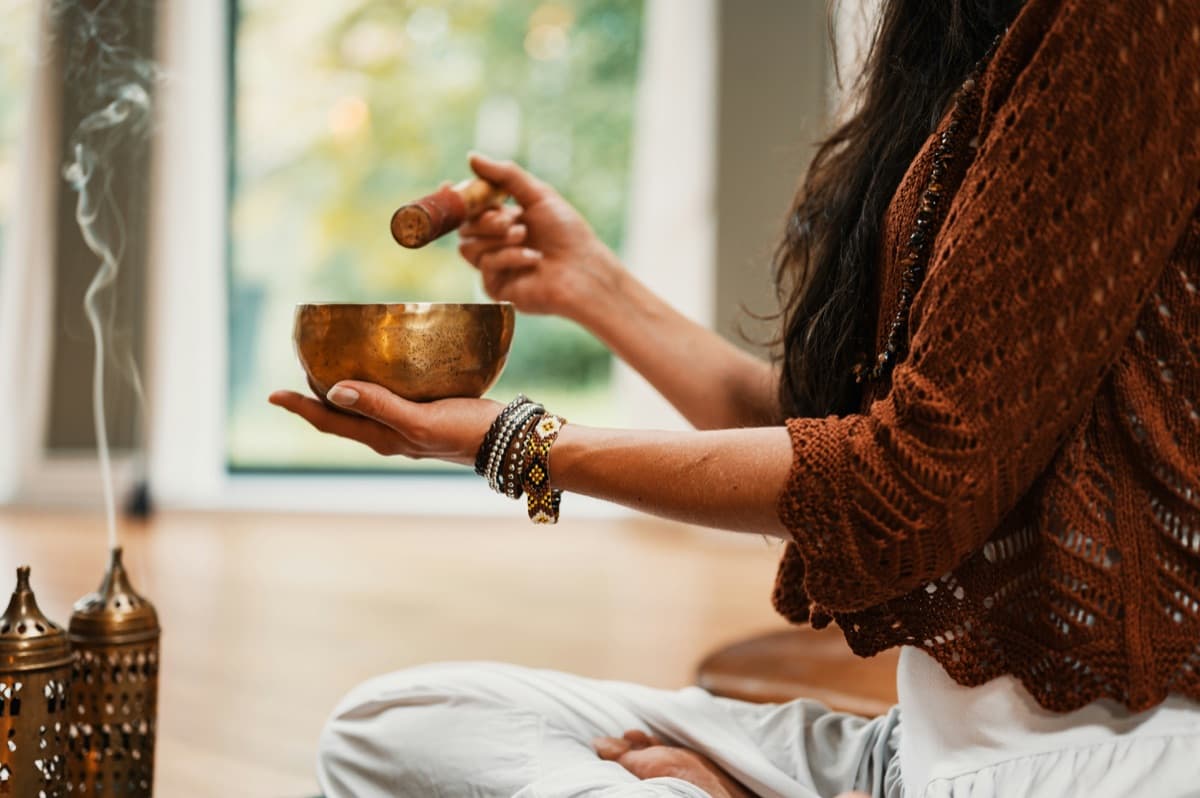
The gong bath is probably the holistic practice with the lowest barrier to entry of all: you lie down, cover yourself, close your eyes and someone else does all the work. You do not need to know how to meditate, you do not need to be flexible, you do not need to share anything with anyone.
That is also why it has become one of the most widespread experiences around, from yoga studios to converted community halls to weekend retreats.
What a sound bath is
A sound bath is a session in which you stay still while a practitioner plays long-resonance instruments. The word "bath" describes the experience: you are immersed in sound, which reaches you from every direction and which you perceive physically too, not only with your ears.
The low vibrations of the gong are felt in the chest, the belly, sometimes the bones. It is this tactile component that separates a sound bath from listening to relaxing music on headphones.
Gongs and singing bowls are not the same thing
They are often mentioned together, but they produce different experiences.
The gong is the most powerful and most unpredictable instrument. A large symphonic or planetary gong generates a dense wall of sound, with overlapping harmonics that create a disorienting effect. It can be overwhelming, especially in the crescendos.
Tibetan singing bowls (more accurately Himalayan bowls) have a more contained, repetitive sound. They are often placed directly on or near the body, and their effect is more localised and gentler.
Many sessions combine the two, along with other instruments:
- Crystal bowls: a pure, penetrating, very high tone.
- Ocean drum: reproduces the sound of waves.
- Koshi chimes and bells: used for transitions and closing.
- Voice and overtone singing: present in some sessions.
How a session unfolds
Before starting
You arrive, take off your shoes, choose a spot. You lie on a mat, usually with a cushion under your head and one under your knees. Covering yourself matters: while you lie still your body temperature drops, and feeling cold spoils the experience. Bring a blanket even if the room seems warm.
The facilitator briefly introduces what will happen and explains how to signal any discomfort.
The session
It usually lasts 45 to 75 minutes. The typical structure is bell-shaped: a soft start, a gradual build of intensity, a denser centre, then a long descent towards silence.
You do not have to do anything. You do not need to concentrate, "empty your mind" or follow your breath in any particular way. If you fall asleep, that is fine — it is so common that experienced facilitators take it for granted.
Closing
The return is gradual: a few minutes of silence, then small movements, then you sit up. Some sessions include a final sharing, almost always optional.
Length and cost
A single session in a city is usually in the range of an evening workshop, typically comparable to a specialised yoga class. Individual sessions with bowls placed on the body generally cost more than group ones.
What it really does
It pays to be precise here, because there is a lot of exaggeration around this topic.
What it is reasonable to expect:
- Deep relaxation, often more marked than what you achieve on your own.
- A drowsy state, between sleep and waking, in which thought becomes less structured.
- Physical sensations of vibration, warmth, tingling, heaviness or lightness.
- Emotions surfacing with no obvious cause: tears, melancholy, relief. It is common and not a problem.
- A sense of calm that lasts a few hours afterwards.
What it is not honest to promise:
- That sound "realigns your chakras" or "reprograms your cells".
- That it cures illnesses, clinical anxiety or depression.
- That a specific frequency has a proven therapeutic effect.
A sound bath does not fix anything. It creates the conditions for the nervous system to allow itself an unusually long pause — and for many people that is already a lot.
If a facilitator presents the session as a substitute for therapy, that is a warning sign. We discuss this in detail in the guide on how to recognise authentic spiritual events.
Contraindications
It is a safe practice for the vast majority of people, but not for everyone. Tell the facilitator before starting if:
- You are pregnant. Many practitioners avoid large gongs, especially in the first trimester, or ask you to lie far from the instruments.
- You have a pacemaker or an implanted device. Check with your doctor first.
- You have epilepsy. Rhythmic, repetitive sounds are a factor to assess with a specialist.
- You have tinnitus or hearing hypersensitivity. The intensity can be unbearable: ask to sit far from the gong.
- You have had psychotic or dissociative episodes. Altered states induced by sound can be destabilising.
A practical tip that applies to everyone: do not put your head a few centimetres from the gong on your first experience, however much it looks like the best spot.
How to choose a serious session
Sound healing is an unregulated field: anyone can buy a gong and organise an evening. What to look at:
- The ratio between participants and space. An overcrowded room where you are squeezed between two strangers defeats the purpose of the practice.
- The health question. If nobody asks you anything, that is already information.
- How volume is handled. An experienced facilitator builds intensity; they do not start at full blast.
- What they say about themselves. Training, how long they have been playing, which instruments.
- What they do not promise. Anyone guaranteeing healing is selling, not facilitating.
You will find the full criteria for assessing who leads in the guide to choosing holistic facilitators.
Frequently asked questions
Do I need to know how to meditate?
No, and that is the strength of this practice. There is no technique to perform: your only task is to stay lying down.
What if I fall asleep?
You have not wasted anything. The body keeps receiving the vibrations, and many facilitators consider sleep a legitimate response, often a sign you needed it.
What should I bring?
Comfortable clothes, socks and a blanket. A cushion if you have one you love. Some spaces provide everything, but it is worth asking first.
Can I take part if I have back problems?
Yes, but tell the facilitator. Lying down for an hour can be uncomfortable: you can lie on your side, put a support under your knees or sit on a chair.
How many sessions do I need to feel benefits?
Many people notice something from the very first time. There is no set cycle to complete: it is a practice you can do occasionally, with no commitment to continuity.
Is there a difference between Tibetan and crystal bowls?
Yes. Metal Himalayan bowls have a warm tone rich in irregular harmonics; crystal bowls have a purer, more penetrating sound, which some people find harsh on the ear.
Is it suitable for children?
Some sessions are designed for families, with shorter duration and lower volumes. Adult sessions with large gongs generally are not.
Conclusion
The gong bath is the simplest entry point into the world of holistic practices: it requires no preparation, no exposing yourself, no belief in anything. You just lie down and let the sound do what it does.
The only thing that really matters is who leads it and in what space. Look for a sound bath among the sound healing events on Wanderer and look at the path of the holistic practitioners who facilitate it before expressing interest.
